
AI and Analytics in Enterprises: What Works in Production
AI and analytics in production: eighteen delivered systems, and what actually survives contact with a real business.

Key Highlights
- The most consequential AI deployment mistakes in 2026 aren’t technical. They’re structural.
- Recent industry research shows that 42% of companies abandoned most of their AI initiatives in 2025, up from 17% the year before.
- For every 33 AI proof-of-concept enterprises start, roughly 4 reach production.
- The strongest predictor of AI returns is whether the workflow was redesigned before the model was chosen.
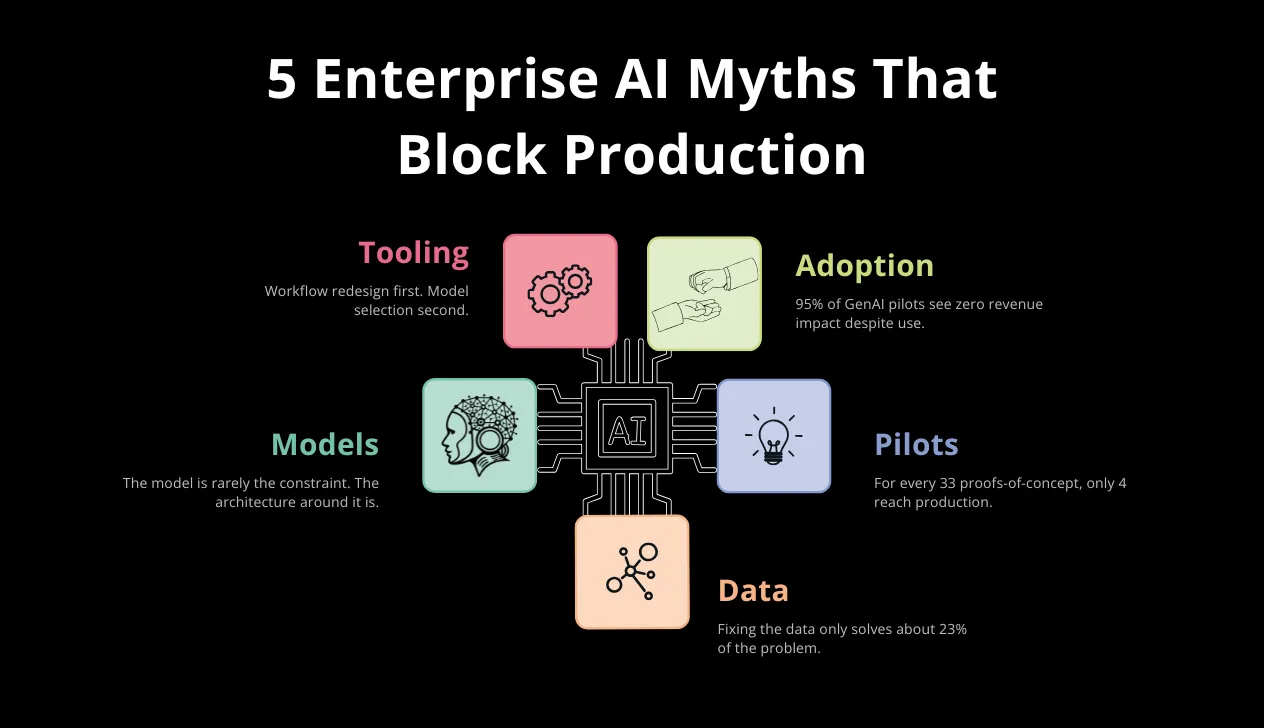
- Five enterprise AI myths consistently block production. Understanding each one is the cheapest part of getting to deployment.
Introduction
The market has more AI mythology in 2026 than any technology wave in recent memory. Some of it comes from vendors. Some come from consultants. A lot of it comes from the natural human tendency to imagine that a new technology fixes the same problems the last one didn’t.
The cost of these myths shows up in the data. According to S&P Global Market Intelligence, 42% of companies abandoned most of their AI initiatives in 2025, up from just 17% in 2024. Recent IDC research found that for every 33 AI proof-of-concept enterprises start, only about four reach production. The MIT Project NANDA study of 300+ enterprise GenAI deployments concluded that roughly 95% see zero measurable revenue impact, despite an aggregate $35-40 billion in spending.
The numbers describe a structural pattern. The same failure modes have appeared across multiple technology waves in different forms, year after year.
This article looks at five of the most consequential myths about enterprise AI deployment, why they persist, and what the patterns of production-ready AI actually look like. The goal is practitioner-grounded: less about what AI could theoretically do, more about what consistently stops it from getting there.
Myth 1: “Once we have the right data, AI will work.”
Few myths get repeated more often than this one. The logic feels intuitive. AI needs data. Bad data means bad output. So if we fix the data, we fix the AI.
The data is real. Gartner has reported that 85% of AI projects struggle when data isn’t AI-ready, and predicts that 60% of AI projects lacking adequate data will be abandoned through 2026.
What gets missed is what comes after the data is fixed. An analysis of 140 enterprise AI implementations found that only about 23% of failures were caused by model performance, data quality, or integration complexity. The remaining 77% came down to strategy, governance, and change management.
In other words, data readiness solves a real but bounded part of the problem. Even when an enterprise has its data infrastructure right, most AI implementations still fail. The reasons are structural: the decision the AI is supposed to inform was never clearly named, the workflow it was meant to support didn’t get redesigned, no one owned the outcome, and there was no feedback loop to learn from what shipped.
Getting the data right is a prerequisite. It is not deliverable. The work of designing the decision architecture around the data still has to happen, and most enterprises haven’t budgeted for it. This is why we always automate the data layer first. It is the foundation the rest of the system stands on, not the finish line.
Myth 2: “Our pilot succeeded, so the deployment will scale.”
This one is responsible for more wasted budget than any other on the list. A pilot delivers a working model, the executive sponsor is excited, the team gets congratulated, and the assumption is that scaling is now an execution problem.
Production tells a different story. The IDC/Lenovo AI CIO Playbook 2025 found that for every 33 POCs an enterprise starts, only four reach production. MIT’s Center for Transportation and Logistics found that fewer than 30% of supply chain AI pilots successfully transition to production systems. And S&P Global’s data on the 17% to 42% abandonment jump from 2024 to 2025 shows the pattern getting more acute, not less.
The reasons are structural. A pilot runs on a clean, static dataset with three motivated people. Production runs on a messy, constantly changing stream of real-world data, with compliance teams, IT security, works councils, and several department heads who each suddenly have a say. The pilot tested whether the model could work in principle. Production tests whether the organization can absorb it.
The right way to design a pilot is to test the production conditions, not avoid them. That means involving compliance, security, and the relevant business owners from week one, not as a final review gate. It means running the pilot against the messy data, not the curated extract. It means defining the production outcome before the pilot starts, not after.
Myth 3: “Better models will solve our AI problems.”
Vendors release new model versions on a monthly cadence in 2026. Each release promises improved reasoning, longer context, faster inference, lower hallucination. The easy mental model is that the next release will fix what the current one couldn’t.
The data shows something different. In the analysis of 140 enterprise AI implementations referenced above, fewer than a quarter of failures came from model performance issues. The remaining three-quarters came from problems that no model upgrade will address: unclear objectives, missing workflow integration, no named owner of the business outcome, no measurement system to tell whether the AI was producing value.
This explains why enterprises that switch from one model to another often see similar results. The model is rarely the constraint. The architecture around the model is.
What this means in practice: model selection is one of the smaller decisions in an AI program. It belongs late in the design process, after the decision the AI will inform has been named, after the workflow has been mapped, after the outcome metrics have been defined. Most enterprises do the opposite. They select the model first, then try to retrofit the architecture around it.
The model is a component. The architecture is the system. Strong systems with average models reliably outperform average systems with strong models.
Myth 4: “AI deployment is fundamentally a tooling decision.”
This myth runs deep in enterprise IT because most enterprise technology decisions are tooling decisions. You evaluate vendors, you run RFPs, you select a platform, you deploy it, you train people on it. The procurement process is mature, and AI gets routed through it by default.
The data suggests AI deployment doesn’t behave like a standard tooling decision. McKinsey’s 2025 research on AI returns found that organizations reporting significant financial returns from AI were roughly twice as likely to have redesigned end-to-end workflows before selecting modeling techniques. The sequence matters. Workflow redesign first, then model selection. Most enterprises do this the other way around, treating AI as a vendor selection followed by a workflow accommodation.
The reason the sequence matters is that AI changes the shape of work, not just the speed of it. A pricing model doesn’t just produce faster price recommendations. It changes who reviews the recommendations, how often, with what authority. A customer service AI doesn’t just answer tickets faster. It changes what humans do, how escalations route, and what the team is measured on. These are workflow questions before they’re tool questions.
The enterprises that get AI right treat it as an operating model change with a tool inside it. The ones that get it wrong treat it as a tool selection that the operating model will accommodate.
Myth 5: “If we just measure AI adoption, value will follow.”
Adoption is measurable. Logins. Queries per user. Active accounts. ROI is hard to measure precisely, and the easy substitution is to assume adoption is a leading indicator of value.
The MIT Project NANDA study from July 2025 directly tested this. Across more than 300 enterprise generative AI deployments, the study found that adoption was widespread but revenue impact was concentrated. Only about 5% of GenAI pilots achieved rapid revenue acceleration. The other 95% saw little or no measurable financial return, despite the $35-40 billion in aggregate spending.
Adoption tells you that people are using the tool. It says very little about whether the tool is changing the business outcomes the investment was meant to improve. A salesperson can use an AI assistant every day and produce the same revenue. A team can run hundreds of analytical queries against a model and make the same decisions they were making without it.
The measurement frame that works in production is different. It tracks the decisions the AI is supposed to inform, the outcomes those decisions produce, and the link between the two. It treats adoption as a hygiene metric, not a value metric. Without that distinction, AI investments look healthier on the dashboard than they are in the financials.
What Actually Works in Production
Across the recent industry research and the engagements we see, a small set of patterns separates AI deployments that reach production and produce returns from the much larger group that doesn’t.
The decision is named before the model is chosen. Production-ready AI starts with a specific decision the AI is meant to inform, with a named owner of that decision, with measurable outcomes attached. Model selection comes after, in service of that decision.
The workflow gets redesigned, not retrofitted. McKinsey’s finding that workflow-redesign-first organizations see roughly twice the AI returns is one of the most underrated insights in the current research. AI changes the shape of work. Designing the work around the AI from the start produces fundamentally different results than bolting AI onto an existing process.
The pilot is designed for production conditions. That means real data, real stakeholders, real compliance reviews, real owners, real outcome measurement. The pilot proves whether the organization can absorb the AI, not just whether the model can work in isolation.
Adoption is treated as a hygiene metric. The metrics that matter in production track the business outcomes the AI was meant to improve, with feedback loops back to the decision the AI informed.
The architecture is deliverable. The model is a component inside a system that includes the data layer, the workflow integration, the named ownership, and the measurement framework. The system is what produces returns. The model alone rarely does.
What we see in our own deployments
We’ve now delivered eighteen AI and analytics systems into real businesses: consumer goods, energy, e-commerce, research. Some patterns keep winning. Others keep dying in staging, no matter how good the demo looked. This is the honest scorecard.
What survives: narrow agents on painful workflows
The single most reliable win is an agent scoped to one hated, high-volume workflow: invoice reconciliation, report assembly, data movement between systems. One reconciliation pipeline we shipped cut a three-month manual finance cycle to a daily automated run and reduced ~₹10 crore a year of bad-stock write-offs by ~90%.
Narrow scope is the feature, not the compromise. The agent sees the same document shapes daily, the exceptions are learnable, and the owner can audit every run.
What survives: forecasting with a simulator on top
Forecasts alone get filed. Forecasts with a scenario simulator get used, because leaders can ask “what if we shift spend?” and watch the revenue line respond before committing. Simulation converts a model into a conversation, and conversations change budgets.
What survives: talk-to-data, with governance underneath
Conversational layers over governed data genuinely kill the analyst-ticket queue; ours answer in seconds what used to take days. The load-bearing word is governed. The same interface over messy data is a confident liar, and one wrong answer to a CFO ends the program.
What dies: everything-at-once
The org-wide moonshot, the chat-with-everything bot, ungoverned RAG over the wiki, the pilot with no named owner, they demo beautifully and die quietly. Not from bad models: from unclear ownership, unbounded scope, and no wire into a real decision.
The pattern behind every failure we’ve autopsied: nobody could say, in one sentence, whose Monday changes when the system works.
The sequence that works
Automate the data first: it kills the manual work and builds the trusted layer. Analytics second: decisions with numbers attached. An application third: one place your team logs into. Every system we’ve shipped that’s still alive a year later followed that order. Every rescue project we’ve inherited skipped step one.
The Finzarc View
The pattern across these five myths is consistent. Most enterprise AI mythology centers the model, the data, or the tool as the gating constraint. In practice, the constraint is almost always architectural: the decision wasn’t named, the workflow wasn’t redesigned, the outcome wasn’t measured, the ownership wasn’t assigned.
This is the work we focus on at Finzarc. Building the decision architecture that turns AI investments into production-ready systems with measurable returns. The model layer matters. The data layer matters. What sits between them and the business is where the gap usually lives, and where the value usually shows up once the gap is closed.
Questions, answered.
What kinds of enterprise AI systems actually survive in production?
Narrow agents scoped to one high-volume, painful workflow: invoice reconciliation, report assembly, data movement between systems. Across eighteen delivered systems, Finzarc finds that narrow scope on a hated workflow beats broad, org-wide ambition almost every time, because the exceptions are learnable and every run is auditable.
Why do enterprise AI pilots fail in production?
Most fail from unclear ownership, unbounded scope, and no wire into a real decision, not from weak models. The tell: if nobody can say in one sentence whose Monday changes when the system works, it dies quietly in staging.
Should we build analytics or automation first?
Automate the data first. It kills the manual work and builds the trusted layer everything else depends on. Analytics comes second (decisions with numbers attached), and a single application to log into comes third.
Is a talk-to-your-data interface safe to put in front of a CFO?
Only over governed data. The same conversational interface over messy, ungoverned data is a confident liar, and one wrong answer to a CFO ends the program.
30 minutes with the founding team. Bring the problem; leave with a scope and a timeline.