
Why FMCG and Retail Leaders Are Still Watching AI Instead of Letting It Act
FMCG and retail AI keeps watching instead of acting. The real blockers, and how bounded autonomy earns AI the right to act on the floor.
Key Highlights
- AI has proven its value in FMCG and retail with documented gains in demand planning and replenishment, yet most inventory decisions still wait for manual approvals.
- The issue is no longer whether AI works; it is whether organizations are ready to trust it enough to let it act.
- Dashboards create an illusion of control but slow action; AI becomes an expensive reporting layer instead of a decision engine when insights wait for reviews and meetings.
- Fragmented data and latency erode trust; without reliable, timely data and clear accountability, AI stays advisory rather than operational.
- Leaders who break through define which decisions AI can take without approval, accept realistic error thresholds, and assign clear ownership for AI-driven outcomes.
- The fastest inventory systems will be the most trusted, not necessarily the most accurate; execution discipline matters more than more tools.
Most FMCG and retail leaders have AI that watches (dashboards, demand alerts, price recommendations) and almost none that acts. The reason isn’t weak models. It’s that a wrong autonomous decision (a mispriced hero SKU, a bad auto-reorder) feels more expensive than a slow human one, and few teams have written down what AI is allowed to do without asking. AI earns the right to act by starting inside tight, reversible boundaries, not by being handed the whole P&L on day one.
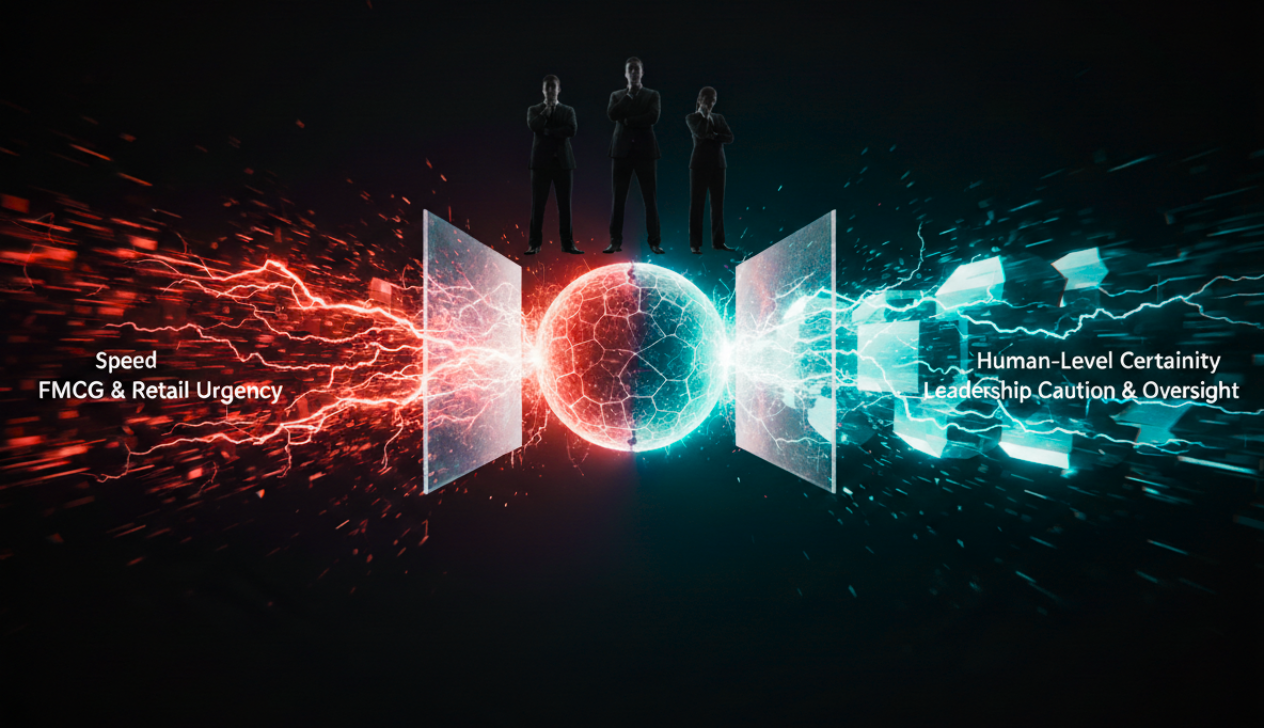
The value itself is no longer in question. Forecast accuracy improvements of 50 to 70 percent are no longer theoretical. They are well documented across demand planning, replenishment, and assortment optimization. Yet despite these gains, most inventory decisions still wait for morning reviews, manual approvals, and spreadsheet checks. Stockouts continue to hurt shelf presence. Excess inventory keeps blocking working capital. The promise of AI exists, but the impact rarely shows up where it matters. Leadership teams want speed, but they still demand human-level certainty. Those two expectations pull in opposite directions, and until that tension is resolved, AI will remain something companies observe rather than something they allow to act.
Why do consumer businesses keep AI in read-only mode?
Because the asymmetry looks obvious: a bad recommendation costs nothing if a human ignores it, while a bad action moves real money on real shelves. So AI gets parked in advisory mode (it flags the stockout, suggests the price, scores the promotion) and a person still clicks the button days later.
Dashboards reinforce this. They give leaders comfort. They centralize information, make performance visible, and preserve the feeling of control. Every number can be checked. Every action can be paused. Every decision can be overridden. What dashboards quietly do, however, is slow everything down. In most FMCG and retail setups, AI insights are generated continuously. Demand spikes, supplier delays, regional shifts, and weather effects surface in real time. Yet action does not follow in real time. It waits for reviews, approvals, and meetings. Watching data feels responsible. Acting on it feels risky. Over time, organizations default to watching, and this is how AI becomes an expensive reporting layer instead of a decision engine.
The flaw is treating the human path as free. It isn’t. Every hop from signal to action leaks time and margin, and in categories that reprice weekly and reorder daily, latency is the cost. Watching feels safe precisely because its price never appears on a dashboard. The stockout you saw Friday and fixed Tuesday is three days of lost sell-through nobody logged as a loss.
Isn’t watching the safe choice?
No, watching has a cost; it’s just invisible. Visibility was never the same thing as control. A chart that doesn’t trigger behavior is decoration, and most consumer-goods analytics programs quietly confuse the two.
McKinsey and others have repeatedly found a meaningful share of operational value lost to problems that were fully visible but acted on too slowly. In FMCG and retail that surfaces as bad-stock write-offs, promotions that miss their window, and forecasts nobody trusts enough to act on. Doing nothing is a decision, usually the expensive one. The competitor price you spotted but re-approved by feel is margin left on the table, every week, at scale.
The hidden business cost of waiting too long to act
Most AI failures in inventory are not prediction failures. They are timing failures. An insight generated at 2 AM is reviewed at 9 AM. The market moved at 6 AM. By the time action happens, the opportunity is already gone.
In FMCG and retail, this delay translates directly into lost shelf availability, emergency replenishment costs, markdowns, and write-offs. Yet latency is rarely measured as a cost. Organizations track forecast accuracy and service levels, but they ignore how long it takes to act. Speed becomes invisible, even though it is often the difference between profit and waste. Latency is the quiet tax every slow system pays.
When data does not line up, trust starts breaking
Inventory data almost never lives in one place. ERP systems, warehouse platforms, order systems, distributor feeds, and store-level data all tell slightly different stories at slightly different times. Teams spend hours reconciling numbers before making even simple decisions.
From a leadership perspective, this fragmentation feels like unreliability. When numbers do not line up perfectly, trust erodes. Not because the signal is wrong, but because it is inconsistent or delayed. Once trust in the data weakens, trust in AI-driven decisions disappears entirely. Leaders hesitate, approvals increase, and automation stalls. Data fragmentation slows more than systems. It slows belief.
How fear of making mistakes stops AI before it starts
As soon as AI moves closer to execution, fear enters the conversation. Leaders worry about incorrect orders, system misuse, and decisions that cannot be explained clearly. Instead of designing safeguards, many organizations freeze autonomy entirely.
Slow certainty feels safer than fast correctness. But slow certainty is still a decision, and it carries its own risk. Manual processes already fail every day. They just feel familiar. When organizations treat AI risk as unacceptable while accepting human error as normal, autonomy never gets a fair chance to prove its value.
Why critical decision logic still lives in people’s heads
Inventory decisions are rarely purely data-driven. Senior planners carry years of experience in their heads. They know which suppliers become unreliable during peak seasons, which SKUs behave strangely during promotions, and which regions always break the rules.
This logic is rarely documented. AI is expected to infer it on its own. When it fails, trust breaks. The problem is not that AI lacks intelligence. The problem is that organizations never translated their own decision logic into systems. AI gets blamed for missing context that leadership never formalized.
What happens when no one truly owns AI decisions
This is where many AI initiatives quietly fail. Leadership teams want the upside of AI but hesitate to own AI-driven outcomes. Responsibility gets spread across committees. Reviews replace ownership. Decisions get delayed until no one is clearly accountable.
AI does not fail first. Decision ownership fails first. Until someone is explicitly responsible for outcomes driven by AI, autonomy will always remain theoretical.
What actually makes leaders comfortable letting AI act?
Boundaries, not bravado. Leaders don’t need AI to be perfect; they need every action to be bounded, reversible, and auditable. That means explicit decision rights: this agent may reprice within a set band inside these guardrails, may auto-create a replenishment task, and must flag anything outside its lane to a named human. Autonomy isn’t a switch. It’s a dial, and it starts low.
This is the real work, and it’s organizational as much as technical. Before scaling autonomy, decide where control should sit, the per-decision trade-offs we lay out in human-in-the-loop vs full autonomy. Pair every acting agent with an audit trail and an escalation path, and “letting it act” stops feeling like a leap of faith and starts feeling like agentic automation with a seatbelt on.
Why chasing perfection ends up killing progress
Many organizations expect AI to be perfect. One edge-case failure becomes a reason to shut projects down. Unusual events are treated as proof that automation is unsafe.
Human decision-making has never been perfect. Errors happen daily. The difference is perception. Human mistakes feel forgivable. AI mistakes feel unacceptable. Without clear error thresholds and transparent explanations, evaluation turns into performance theatre. Projects stall, trust erodes, and momentum disappears.
Where should AI act first in FMCG and retail?
Start where decisions are high-frequency, reversible, and rules-clear, not where they’re strategic and rare. Daily reconciliation of sales, stock, and invoices is the highest-ROI place to let agents act, because errors surface immediately and nothing is irreversible. Price approvals inside a guardrail band come next: the system proposes and applies within limits while humans handle the exceptions, exactly the shape of our pricing approval tool.
From there, competitor repricing signals and forecast-led allocation. On one brand-optimisation platform we shipped across 7 brands, the flagship line took +27% revenue with margin up from 30% to 38%, because leadership finally trusted a system enough to let its numbers drive budgets instead of decorate slides. The sequence that gets the money moving is always the same: reconcile the data, forecast the demand, simulate the revenue, then let it act.
What teams that move faster consistently do differently
Organizations that successfully move from dashboards to autonomous decision-making share a few consistent behaviors. They clearly define which decisions AI can take without approval, especially low-risk and high-frequency ones. They accept that some errors are inevitable and price them realistically. They test decisions in simulated environments before deploying them live. They demand explanations in plain business language, not technical output. Most importantly, they assign clear ownership for AI-driven outcomes.
These teams do not trust AI blindly. They trust it deliberately, through design rather than hope.
Why do pilots stay stuck in watching?
Because most pilots were scoped to demo insight, not to take an action. Industry surveys keep finding that a majority of AI pilots never reach production, and the reason is rarely the model. It’s that the pilot ended in a dashboard and a slide, with no owner, no decision rights, and no path to the floor. That quiet failure mode is exactly what we describe in where AI pilots quietly fail inside organizations. A watching pilot always looks successful in the room and changes nothing on the shelf.
The fix is to scope the pilot around a single acting loop from day one: one decision, one guardrail, one owner, one reversible action, measured. If you can’t name the action the AI will take and the person accountable for its lane, you’re not building automation. You’re commissioning another report.
The leadership decision that can no longer be postponed
In 2026, FMCG and retail leaders will not be judged by whether they adopted AI. That will be assumed. They will be judged by whether they trusted it enough to let it influence real decisions.
The fastest inventory systems will not be the most accurate. They will be the most trusted. If your organization is still debating instead of testing feasibility, that decision is already costing you.
The shift that matters
The gap between leading and lagging consumer businesses in 2026 won’t be who has the best model. It’ll be who let it act. Watching is comfortable; acting is where the margin is. Bring one decision you’d trust an agent to make inside a tight boundary, and the loop (signal, guardrail, action, audit) is a three-week build, not a transformation program. The people who keep watching will keep writing off the same stock next quarter.
How Finzarc helps
Finzarc is industry-agnostic and execution-first. We do not run long experiments or proof-of-concept theater. We take ownership of real business bottlenecks and ship working systems.
We design systems that plug into your existing stack, work with how your teams already operate, and shorten the distance between insight and action. When approvals stall decisions, reports pile up, or manual handoffs slow teams down, we redesign the system around speed, clarity, and accountability. The result is not more dashboards or models. It is fewer decisions stuck in meetings and more actions happening on time.
We typically deliver this in half the cost and a quarter of the time compared to traditional builds, without locking teams into fragile setups. If you are evaluating where AI can make a measurable difference in inventory, planning, or operational decisions, share your use case with us. We will help you map a focused 90-day plan that prioritizes execution, ownership, and outcomes over noise.
Book a conversation when you are ready to stop observing and start shipping.
Questions, answered.
Why do FMCG and retail leaders keep AI in watch-only mode?
Because a wrong autonomous action feels costlier than a slow human one, so AI gets parked in advisory mode, flagging stockouts and suggesting prices while a person acts days later. The hidden cost is latency: in categories that reprice weekly and reorder daily, watching leaks margin that never shows up on a dashboard.
How can AI act on pricing or replenishment without risking the P&L?
By keeping every action bounded, reversible, and auditable. Define explicit decision rights: reprice within a set band inside guardrails, auto-create a replenishment task, escalate anything outside its lane to a named human. Autonomy is a dial that starts low, not a switch you flip on.
Where should a consumer business let AI act first?
Start with high-frequency, reversible, rules-clear decisions: daily reconciliation of sales, stock and invoices, then price approvals inside a guardrail band. Finzarc ships these acting loops first because errors surface immediately and nothing is irreversible. The trust to widen autonomy is earned from there.
Why do so many retail AI pilots never move past dashboards?
Because they were scoped to demo insight, not to take an action. A pilot that ends in a dashboard has no owner, no decision rights, and no path to production. Scope it instead around one acting loop: one decision, one guardrail, one owner, one reversible action, measured.
30 minutes with the founding team. Bring the problem; leave with a scope and a timeline.