
3 AI Breakthroughs Reshaping How Every Industry Operates in 2025
AI breakthroughs 2025: agents that act, reasoning models, and collapsing inference cost: the three shifts rewriting how industries operate.

Key Highlights
- AI is no longer a future concept; it is already restructuring decisions, work flows, and value creation across finance, FMCG, HR, and manufacturing.
- The winning formula combines agentic AI systems with disciplined execution frameworks, not just new tools.
- Agentic AI is becoming a true virtual coworker: autonomous agents handle multi-step tasks, monitor dashboards, and trigger workflows without constant human direction.
- Reasoning models now work through multi-step problems before answering, making AI reliable enough for decisions that carry money.
- The cost of running a capable model fell by more than two orders of magnitude in roughly two years, turning production AI from a research-budget line item into a per-feature decision.
- Predictive operations are making downtime and leakage visible; manufacturing and FMCG are deploying predictive maintenance and marketing mix models in weeks, not years.
- Multimodal AI is reaching the frontline with voice assistants in local languages, driving adoption where the interface becomes invisible.
- Leaders should connect agents to real workflows, measure time to action, build for accessibility, and put governance in place now.
Three shifts defined AI in 2025: agents that take actions instead of just answering questions, reasoning models that work through a problem before responding, and a collapse in inference cost that made production AI cheap enough to be obvious. Individually they’re features. Together they moved AI from a demo you watch to software that quietly does the work, which is why every industry’s operating model is being rewritten around them.
Setting the stage: AI is no longer a future concept
From finance and FMCG to HR and manufacturing, one thing is clear: AI is not a “coming soon” story anymore. It’s already at work, restructuring how decisions are made, how work flows, and where value is created.
Yet, across industries, the same issues persist. There’s too much data, too many manual steps, and too many delays between decisions and execution. The winning formula is proving to be a mix of agentic AI systems and disciplined execution frameworks.
McKinsey calls this shift the move from chat to agents. Microsoft’s 2025 Work Trend Index points out that today’s work is drowning in interruptions and handoffs. Leaders are responding by redesigning workflows, not just buying new tools.
Breakthrough one: agents that act, not chatbots that answer
The biggest change is that AI stopped answering and started doing. An agent plans a task, calls tools, checks its own output, and completes a workflow end to end, with no human relaying each result to the next step. That’s the line between a copilot and a worker with a job description.
The major upgrade this year isn’t better chat. It’s autonomous agents that handle multi-step tasks, monitor dashboards, trigger workflows, and follow up, without being told. Leaders are moving away from tools that assist and toward systems that act. The best implementations let humans focus on judgment and relationships, while agents manage the grind.
Reconciliation, ticket triage, first-draft analysis, invoice matching, data cleanup: these are now jobs, not conversations. The interesting question stopped being “how good is the answer” and became “did the task get done.” We build AI agents and agentic automation into exactly these seams; the progression from agents to agentic AI is the map for where each one fits. On a single reconciliation build we returned 60,000+ hours of manual effort. That’s what agents replacing toil actually looks like, not a chat window.
Why it matters now: Microsoft reports that Copilot tools save employees an average of 25 to 26 minutes per day. UBS logs over a million AI prompts each month to assist financial advisors. Wealth firms are deploying copilots to prep materials and summarize meetings so humans can focus on clients, not screens.
Breakthrough two: models that reason before they answer
The second shift is reasoning. Models now spend compute working through a problem step by step at answer time, instead of pattern-matching a single plausible response, and that’s what makes them reliable enough for decisions that carry money.
This matters wherever a wrong-but-confident answer is expensive: pricing logic, root-cause investigation, code, financial checks. A reasoning model that shows its steps can be audited, corrected, and trusted with judgement a chatbot never earned. The tradeoff is real (reasoning is slower and costs more per call), so you deploy it where correctness beats latency and keep lighter models for high-volume, low-stakes work. Most of our LLMs in production work is drawing exactly that boundary, as we did building an organisation-wide GPT that had to answer from real internal data without inventing.
Breakthrough three: the cost of intelligence fell off a cliff
The third and least-discussed breakthrough is economics. The cost of running a capable model dropped by more than two orders of magnitude in roughly two years, and open-weight models closed most of the gap to the frontier. Stanford’s AI Index tracked the price of GPT-3.5-level inference falling by a factor of hundreds over that window.
What used to be a research-budget line item became a per-feature decision. Open weights changed the calculus again: you can run capable models on your own infrastructure and keep sensitive data inside your VPC, which is what unblocks regulated industries. The bottleneck moved from “can we afford this” to “can we wire it into the business.” Getting that wiring right is where GPU cost in enterprise AI systems and disciplined data engineering and pipelines decide whether the economics actually land in production.
Predictive operations make downtime and leakage visible
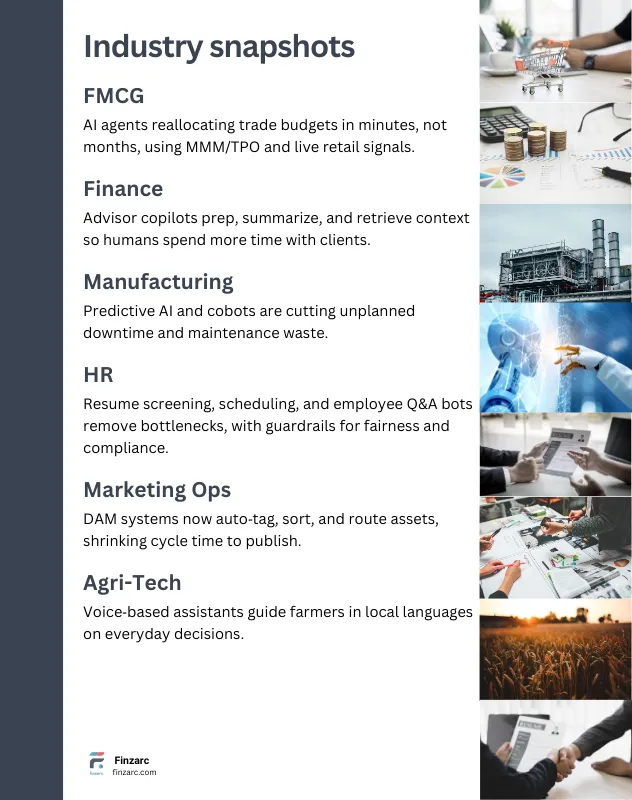
Manufacturing plants are using AI-powered predictive maintenance to reduce surprise breakdowns and smooth out bottlenecks in labor and parts.
Why it matters now: Thanks to cloud infrastructure, edge sensors, and plug-and-play model libraries, predictive systems can be deployed in weeks. They’re no longer reserved for elite facilities. Even cautious rollouts focused on critical assets are delivering real savings.
In the FMCG world, this logic is being applied to budgets. Brands are using marketing mix models and real-time analytics to spot waste and shift spend dynamically. It’s becoming essential as pricing advantages shrink and volume pressure returns.
Multimodal AI finally reaches the frontline
Voice assistants that speak local languages are starting to show up on farms, in field service, and across rural India.
India’s ecosystem is setting an example. Tools now guide farmers on crop health, pricing, and government programs, all in their native languages, on familiar platforms like WhatsApp or basic phones.
Why it matters now: Once users can speak naturally and be understood, adoption surges. The interface becomes invisible. Expect a rise in domain-specific agents across logistics, agri-tech, healthcare, and customer service.
Which industries feel this first?
The gap opens first where decisions are frequent, data-rich, and currently bottlenecked on people: FMCG and retail pricing, supply chain, and any back office drowning in reconciliation and reporting. Those are the places where an agent, a reasoning model, and cheap inference stack up into a visible number.
Pricing is the sharpest example: prices move daily, the data exists, and the decision usually waits on a committee. Wire the three breakthroughs into that loop and margin stops leaking, the shape of our BrandOptix revenue build, and the wider argument in where AI actually improves revenue in retail and FMCG. The pattern generalises to any high-frequency decision that today sits in a queue.
So what should you do about it in 2025?
Pick one workflow where a person currently relays information between steps, and automate that seam. Don’t launch a company-wide “AI strategy” and wait a year. The three breakthroughs compound only when they touch a real process with an owner and a number attached.
This is also why so many pilots stall: they’re demos without a workflow, impressive in the room and orphaned the week after. The ones that survive are wired to a metric someone is measured on, which is the pattern behind where AI pilots quietly fail inside organizations. Speed is the moat: models are converging, so the execution advantage goes to whoever ships first. We put a first working delivery in front of a team in about three weeks, and our builds have recovered ₹4.2 Cr and lifted revenue 27% on an FMCG engagement, not because the models were secret, but because they were connected to the business.
What leaders should do next
1. Connect your agents to real workflows. Don’t stop at sandbox pilots. Real value appears when AI tools plug into approvals, scheduling, or backend systems.
2. Measure time to action. Beyond accuracy, focus on how quickly work moves from decision to execution. Track deflection rates and hours saved.
3. Build for accessibility. If your team or customers use different languages or rely on mobile devices, local-language voice tools are essential, not optional.
4. Put governance in place now. Laws like the EU AI Act and NYC AEDT are live. Build audit trails, human oversight, and fairness checks into every workflow.
How Finzarc helps
At Finzarc, we are industry-agnostic and problem-obsessed.
We design AI agents that plug into your stack, speak your team’s language, and reduce the time between insight and action. Whether you’re slowed down by approvals, reports, or manual handoffs, we can automate it, optimize it, and scale it.
All in half the cost and a quarter of the time.
Let’s talk
Where is AI making the biggest impact in your space?
Drop your use case or schedule a quick strategy session. We’ll sketch your 90-day transformation plan.
The breakthroughs are real. The advantage goes to whoever ships them into a workflow first. Working software > promises of future.
Related Resources
Questions, answered.
What were the biggest AI breakthroughs of 2025?
The three that mattered most: AI agents that take actions end to end rather than just answering, reasoning models that work through multi-step problems before responding, and a steep fall in inference cost that made production AI affordable for everyday workflows.
What is agentic AI, and how is it different from a chatbot?
An agent plans a task, calls tools, checks its own output, and completes a workflow without a human relaying each step; a chatbot only responds to a prompt. Finzarc builds these agents into real operations (reconciliation, triage, data pipelines) where they return measured hours rather than impressing in a demo.
Are reasoning models worth the extra cost and latency?
Yes, where correctness carries money (pricing logic, root-cause analysis, code, financial reconciliation), because a plausible-sounding wrong answer is expensive there. For high-volume, low-stakes tasks, a cheaper and faster model is the right call.
How should a company start acting on these AI breakthroughs?
Pick one workflow where a person currently relays information between steps and automate that seam, instead of launching a company-wide AI strategy. Finzarc ships a first working delivery in about three weeks so you can see the loop close before committing to more.
30 minutes with the founding team. Bring the problem; leave with a scope and a timeline.