
6 AI Adoption Challenges Leaders Can’t Ignore in 2026
AI adoption challenges in 2026: the six walls (talent, trust, data, integration, governance, ROI) that stall enterprise AI, and how to clear them.
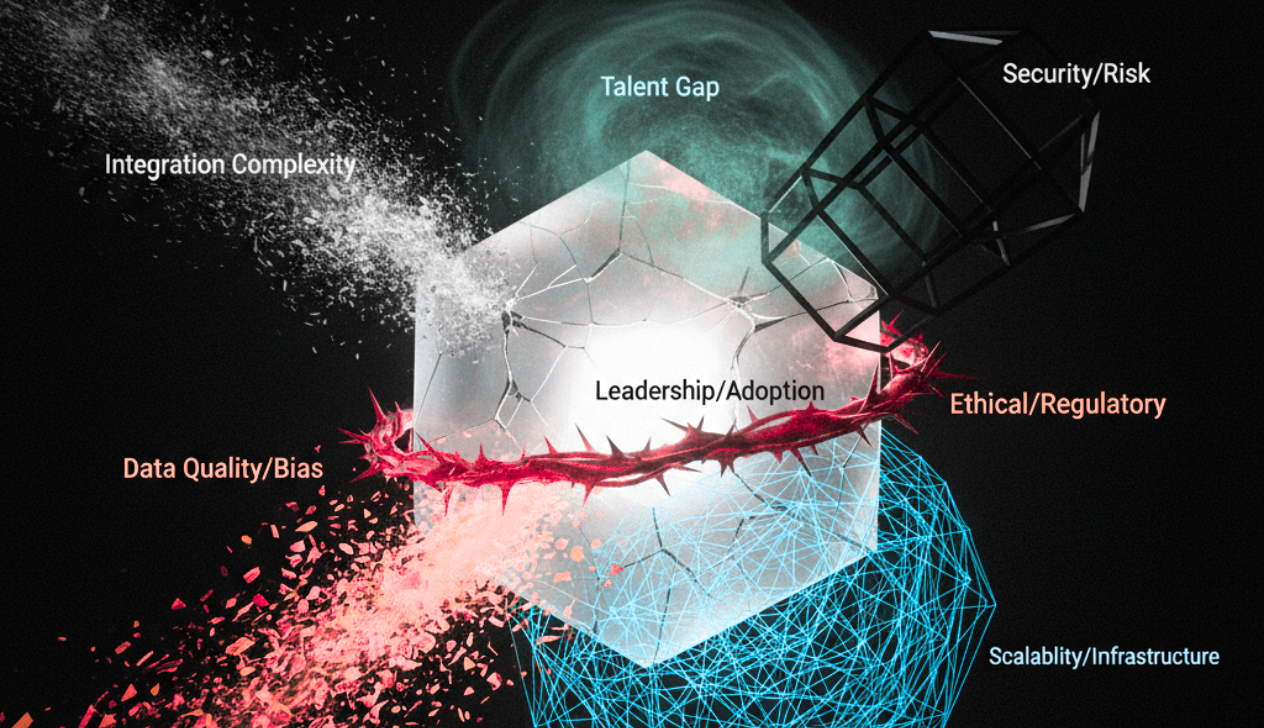
Key Highlights
- AI adoption is widespread, but value creation is not. Nearly 90% of enterprises use AI, yet most fail to scale it beyond pilots into sustained business impact.
- The biggest barriers to AI success are organizational, not technical. Weak governance, unclear ownership, skill gaps, and outdated workflows slow adoption more than technology limitations.
- Trust and data quality determine whether AI influences decisions. Without transparent models, reliable data, and clear accountability, AI remains advisory rather than operational.
- ROI ambiguity kills momentum. AI initiatives that are not tied to measurable business outcomes struggle to secure long-term funding and executive sponsorship.
- Workflow redesign is the real driver of scale. Only a small share of organizations redesign core workflows around AI, but those that do see consistent productivity and performance gains.
- Enterprise-wide capability building matters more than specialist teams. Organizations that invest in training across functions scale AI faster and embed it into daily operations.
- Leaders must shift from experimentation to execution. The competitive advantage lies in focus, ownership, and disciplined scaling, not in chasing the next AI tool.
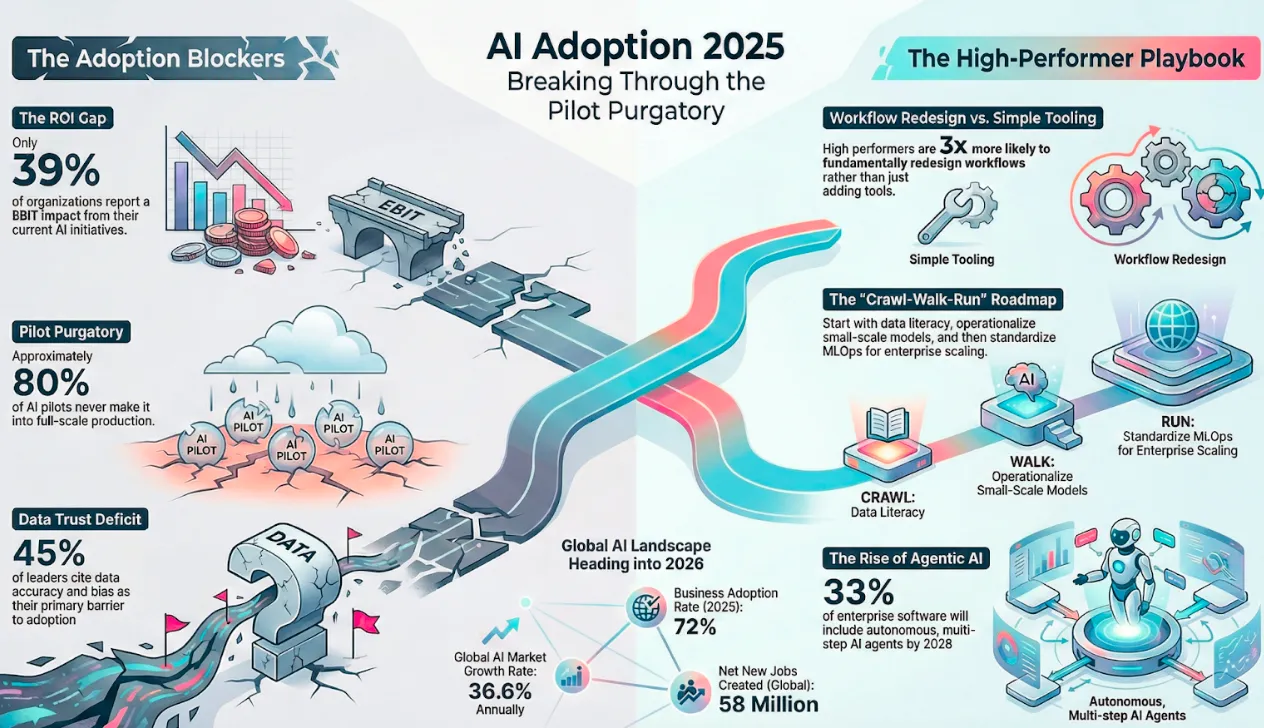
Most AI programs don’t fail on the model. They fail on the six things around it: talent, trust, integration, data readiness, governance, and the gap between a pilot and production. In 2026 the technology is the easy part: adoption is the bottleneck, and every one of these walls is an organizational problem wearing a technical mask.
Artificial intelligence has become impossible to ignore in boardrooms. Budgets are approved, tools are deployed, and teams are under pressure to “do something with AI.” Yet behind the momentum, a harder truth is emerging. While adoption numbers continue to rise, measurable business impact remains uneven. Many enterprises have implemented AI across functions, but far fewer have succeeded in turning that activity into sustained financial results. The growing gap between adoption and value is forcing senior leaders to confront a critical question: why is AI so widely used, yet so rarely a real advantage at scale?
According to McKinsey’s global State of AI report, 2025, nearly 90 percent of organizations now report regular use of AI across business functions. However, the same research shows that most enterprises remain stuck in the early stages of scaling. This contrast highlights a growing disconnect: while AI tools are widely available, enterprise-wide integration strategies are often missing. As a result, value remains trapped in what has become known as pilot purgatory.
Key challenges preventing AI from delivering real enterprise value
When AI fails to scale, the problem is rarely the technology. In most organizations, the ambition to use AI moves faster than the organization’s ability to absorb it. What slows things down are structural and behavioral gaps that quietly block AI from influencing real decisions. The same challenges show up again and again across industries, and none of them are AI problems at heart: they are execution problems wearing a technical mask.
1. Data integrity and trust deficits
Senior leaders hesitate to rely on AI outputs when they cannot understand how a decision was reached. If a model produces a recommendation but cannot explain its reasoning in business terms, that recommendation stays secondary to human judgment. AI becomes something to consult, not something to act on. A model the business doesn’t trust is shelfware, whatever the eval score says. Adoption dies quietly when a sales lead or a plant manager glances at the AI’s answer and reverts to the spreadsheet they’ve trusted for a decade. Accuracy earns you a pilot; trust earns you usage.
Organizations that scale AI successfully address this early. They put clear ownership around data quality, document the logic behind AI-driven decisions, and define when and how humans step in. You buy trust by showing the work: traceable sources, confidence signals, and a visible human in the loop for anything high-stakes. The right question is rarely “how autonomous can this be?” but “where should a person still sign off?” When leaders know where the data comes from, how decisions are formed, and who is accountable, trust builds naturally. Trust is a design decision, made early, not a feature you retrofit after the business has already stopped opening the tool. At that point, AI stops being advisory and starts becoming operational.
2. Limited access to business-specific data
Generic AI models struggle to capture the nuances of a specific business. Without enough high-quality internal data, models fail to reflect real operating conditions, customer behavior, or edge cases that matter day to day. Having data is not the same as having data an AI can use. Fragmented sources, undocumented tables, and tangled permissions are the most common reason a promising pilot never scales: the model is ready long before the data is.
The trap is concluding you need a two-year platform program first. You don’t. High-performing organizations expand their usable data without increasing risk. They enrich existing datasets in controlled ways and allow models to learn from distributed data sources while keeping sensitive information protected. The goal is not more data for the sake of it, but better data that reflects how the business actually works. You need the specific slice your use case depends on to be clean, joined, and accessible, and you can build that in weeks, not quarters. Fix the slice, prove the value, then widen. That’s the pragmatic path we take with data engineering and pipelines, scoped to the decision, not to an org chart’s wish list.
3. The enterprise AI expertise gap
Many teams can experiment with AI tools, but few know how to embed them into core systems and workflows. As a result, AI stays on the side, handled by a small technical group instead of becoming part of daily operations. The scarce skill in 2026 isn’t building models: it’s the people who can take one to production and keep it running. The market is crowded with prompt-tinkerers and deck-makers; the constraint is engineers who understand pipelines, evaluation, and the messy last mile of integration. A headcount plan won’t close that gap fast enough, and a twelve-month hiring cycle rarely survives contact with a board that wants results this quarter.
Organizations that move past this invest deliberately in capability building. They train existing teams, simplify development through low-code and no-code tools, and reduce dependence on a handful of specialists. Two moves work in parallel: partner with a team that already ships, and make sure the people who scope your build are the people who build it. That single test filters most of the noise. More in our checklist for shortlisting a vendor who ships. When AI skills are spread across functions, adoption accelerates and bottlenecks disappear.
4. Unclear financial accountability
AI initiatives often lose momentum because their impact is hard to measure. Without a clear link to business outcomes, funding becomes uncertain and executive sponsorship fades. ROI ambiguity kills momentum faster than any technical limitation.
Leaders who succeed flip the approach. They start with a concrete business problem, such as reducing processing time or improving forecast accuracy, and then apply AI to it. Success is measured using the same metrics as any other strategic initiative. When AI performance is evaluated in financial and operational terms, it earns its place on the roadmap.
5. Privacy, security, and regulatory concerns
Fear of data leakage or regulatory violations slows deployment and limits scale. In many cases, this leads to excessive caution and delayed rollouts. Governance isn’t a compliance checkbox you bolt on at the end: it’s deciding, before you ship, who is accountable when the model is wrong. Gartner expects a large share of agentic AI projects to be scrapped before 2027, and unclear ownership is a quiet driver: nobody wants to sign for a system whose failure modes were never defined.
Mature organizations treat security and compliance as design fundamentals, not afterthoughts. Data protection, anonymization, and regular risk reviews are built into systems from day one. The fix is boring and effective: decision rights, audit trails, escalation paths, and hard boundaries on what the AI may do unsupervised. This reduces uncertainty and allows teams to move forward with confidence rather than hesitation. For anything touching regulated data, that discipline is the difference between shipping and stalling, as we cover in scaling LLM applications without breaking compliance.
6. Workflow inertia and integration gaps
One of the most common mistakes is layering AI on top of inefficient processes. When underlying workflows are broken, AI can only deliver limited gains. And if the AI lives in its own tab, it’s a demo; adoption starts only when it reaches into the ERP, CRM, and the workflow people already open every morning. This is where most pilots quietly stall: integration is unglamorous, and it’s where the real engineering hours go. A chatbot that can’t read the order book or write back to the ticketing system asks people to do more work, not less, so they don’t.
Organizations that see meaningful returns use AI as a reason to rethink how work is done. Instead of automating existing steps, they redesign workflows so AI handles routine planning, prioritization, or execution. Human teams are then freed to focus on decisions that actually require judgment. The build that sticks meets users inside their existing tools. That’s the difference between a slide and something like an organisation-wide GPT wired into internal systems that people actually reach for.
How leading organizations build scalable AI capabilities
While nearly 90 percent of organizations report using artificial intelligence regularly in at least one business function, the vast majority struggle to move beyond isolated use cases. Only a minority of enterprises have successfully translated AI adoption into consistent, company-wide value. To bridge this gap, leaders are moving away from experimentation and toward a structured architecture for scale.
1. Linking Adoption to Measurable Metrics
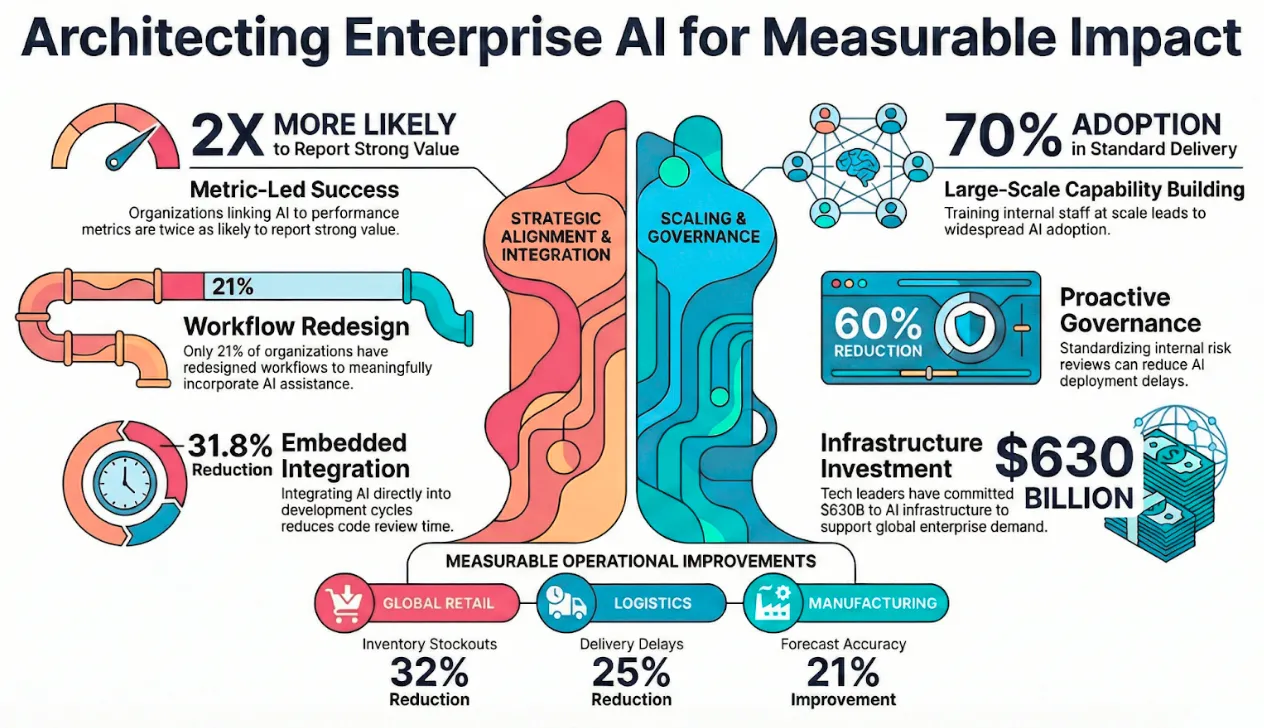
The most successful organizations define success before deployment. By explicitly tying AI initiatives to metrics like revenue growth, cost reduction, or productivity, companies are significantly more likely to see a financial impact. Research indicates that 63 percent of organizations with clear performance metrics reported strong value, compared to fewer than 30 percent of those without them. For example, one global retailer maintained executive support by demonstrating that AI-driven forecasting led to a 32 percent reduction in inventory stockouts.
2. Integrating AI into Core Workflows
Deploying AI tools as standalone solutions rarely delivers long-term results; instead, it must be embedded into daily operations. Currently, only about 20 to 21 percent of organizations have redesigned their core workflows to incorporate AI. Those that do see repeatable gains: an enterprise-scale study found that embedding AI directly into development processes resulted in a 31.8 percent reduction in code review cycle time and a 28 percent increase in deployment volume.
3. Building Broad Internal Capability
Scaling AI is as much about people as it is about technology. Organizations with structured internal training programs are nearly twice as likely to scale AI across multiple functions. One global consulting firm trained over 50,000 employees in a single year, leading to AI being incorporated into over 70 percent of client engagements within 18 months. This allows AI to move past technical specialists and into core business roles.
4. Sustaining Enterprise-Scale Investment
Leaders treat AI as a long-term operational capability rather than a one-off project. This commitment is reflected in the more than $630 billion major tech firms have recently spent on computing infrastructure and AI capabilities. This level of investment enables massive operational shifts, such as an international logistics company reducing delivery delays by 25 percent through predictive analytics.
5. Proactive Governance and Compliance
Security, privacy, and regulatory risks are cited by 40 percent of organizations as primary obstacles to scaling AI. Top-tier firms address these concerns early by building governance into the deployment process. A global financial institution, for instance, reduced deployment delays by 60 percent by standardizing internal reviews for data ethics and model risk before rollout. Similarly, embedding audit controls into data architecture from the start allows healthcare providers to scale AI without needing repeated compliance approvals.
From pilots to performance: what enterprise leaders must do next
The question facing leadership teams today is no longer whether artificial intelligence should be adopted. That decision has already been made across most industries. The real question is whether current efforts are structured to deliver sustained business value or whether they will remain trapped in isolated experimentation. The hardest challenge isn’t starting an AI project: it’s finishing one. MIT’s 2025 research found the overwhelming majority of enterprise GenAI pilots never reached measurable P&L impact; they demoed well and then evaporated. Much of that waste traces to one early decision, a throwaway proof of concept vs a narrow production build, and most teams pick the version that never ships.
Organizations that fail to move beyond pilots typically make the same mistakes. They treat AI as a technology initiative rather than an operating model change. They measure activity instead of outcomes. They allow fragmented ownership across teams, which dilutes accountability and slows decision-making. Pilots are cheap to start and expensive to abandon, and most die in the gap between “it works in the notebook” and “it runs in the business.” More on exactly where projects die in why AI pilots quietly fail inside organizations. Leaders who succeed take a different approach. They treat AI as a core business capability that requires the same discipline applied to finance, operations, or risk management. This starts with clarity on where AI should be applied and, just as importantly, where it should not. Not every process needs intelligence layered onto it, and not every use case deserves to be scaled.
The immediate priority for leadership is focus. That means identifying a small number of business-critical areas where AI can materially improve performance and committing to them fully. It also means stopping initiatives that show activity but lack a clear path to measurable impact. The antidote is scope discipline: pick one narrow, high-value use case, ship a working delivery fast, and let real usage tell you what to build next. Equally important is ownership. Scalable AI does not thrive in experimentation labs alone. It requires senior sponsorship, clear governance, and defined accountability across data, technology, and business teams. Without this structure, even well-funded initiatives struggle to move into production.
Finally, leaders must recognize that AI maturity is not a one-time milestone. It is an ongoing capability that evolves with data quality, workforce skills, and business strategy. Organizations that continuously review outcomes, refine workflows, and invest in internal capability will compound value over time. Those that do not will continue restarting pilots under different names.
The future belongs to enterprises that move decisively from experimentation to execution. The task for leadership is not to chase the next tool, but to build the conditions under which AI consistently improves decisions, operations, and outcomes at scale.
Where Finzarc fits into this journey
Most organizations struggling with AI adoption in 2026 do not need more tools. They need execution discipline, not another advisory layer: the difference between AI consulting and AI development. This is where Finzarc fits in.
Finzarc works with leadership teams to move AI out of pilots and into real operating workflows. We focus on the gaps that stall value creation, unclear ownership, slow approvals, fragmented data, and AI systems that advise but never act. Instead of layering AI on top of broken processes, we redesign decision workflows so AI can operate with speed, accountability, and measurable impact.
Our approach is practical by design. We help define where AI can act autonomously, where human oversight is required, and how outcomes are measured in business terms like cost, revenue, and time saved. We build agents that integrate into existing stacks, explain decisions in plain language, and reduce the latency between insight and action. This allows leadership teams to scale AI responsibly without losing control. Finzarc ships a first working delivery in about three weeks, an approach that has already returned 60,000+ hours to client teams.
If your organization is serious about moving from experimentation to execution, Finzarc helps you identify high-impact use cases, redesign workflows around them, and deliver results in weeks, not quarters.
None of these six challenges are AI problems. They’re execution problems, and execution is the only thing that ships. Pick the wall in front of you, clear it, and put working software in someone’s hands. Working software beats promises of future capability, every time.
Schedule a conversation if your organization wants to turn AI from an advisory layer into a trusted execution engine, and move faster on real decisions.
Sources
Questions, answered.
What is the biggest barrier to enterprise AI adoption in 2026?
The gap between pilot and production. The model usually works; what stalls is talent, trust, integration, data readiness and governance around it. MIT’s 2025 research found the overwhelming majority of enterprise GenAI pilots never reached measurable P&L impact, an execution problem, not a technology one.
Why do most AI pilots fail to scale?
They live in a separate tab. A pilot that never touches the ERP, CRM or the workflow people already use stays a demo. Adoption happens only when the AI reaches into the systems where work is done and the data it needs is actually usable.
How does Finzarc help leaders get past AI adoption challenges?
Finzarc scopes a narrow, high-value use case and ships the first working delivery in about three weeks, with integration, evaluation and human-in-the-loop controls built in, not bolted on. The people you meet in scoping are the people who build. To date that approach has returned 60,000+ hours to client teams.
Do we need a two-year data platform before adopting AI?
No. You need the specific slice of data your first use case depends on to be clean, documented and accessible. Full-platform programs are a common reason promising pilots never ship. Fix the slice, prove value, then widen.
Who should own AI governance?
Governance is a business decision, not a late compliance checkbox. Decide who is accountable when the model is wrong (decision rights, audit trails and escalation paths) before you ship, not after an incident.
30 minutes with the founding team. Bring the problem; leave with a scope and a timeline.